Tactical Grid
A downloadable game for Windows
Tactical Grid
Fight anywhere on Earth. Command what you can't see.
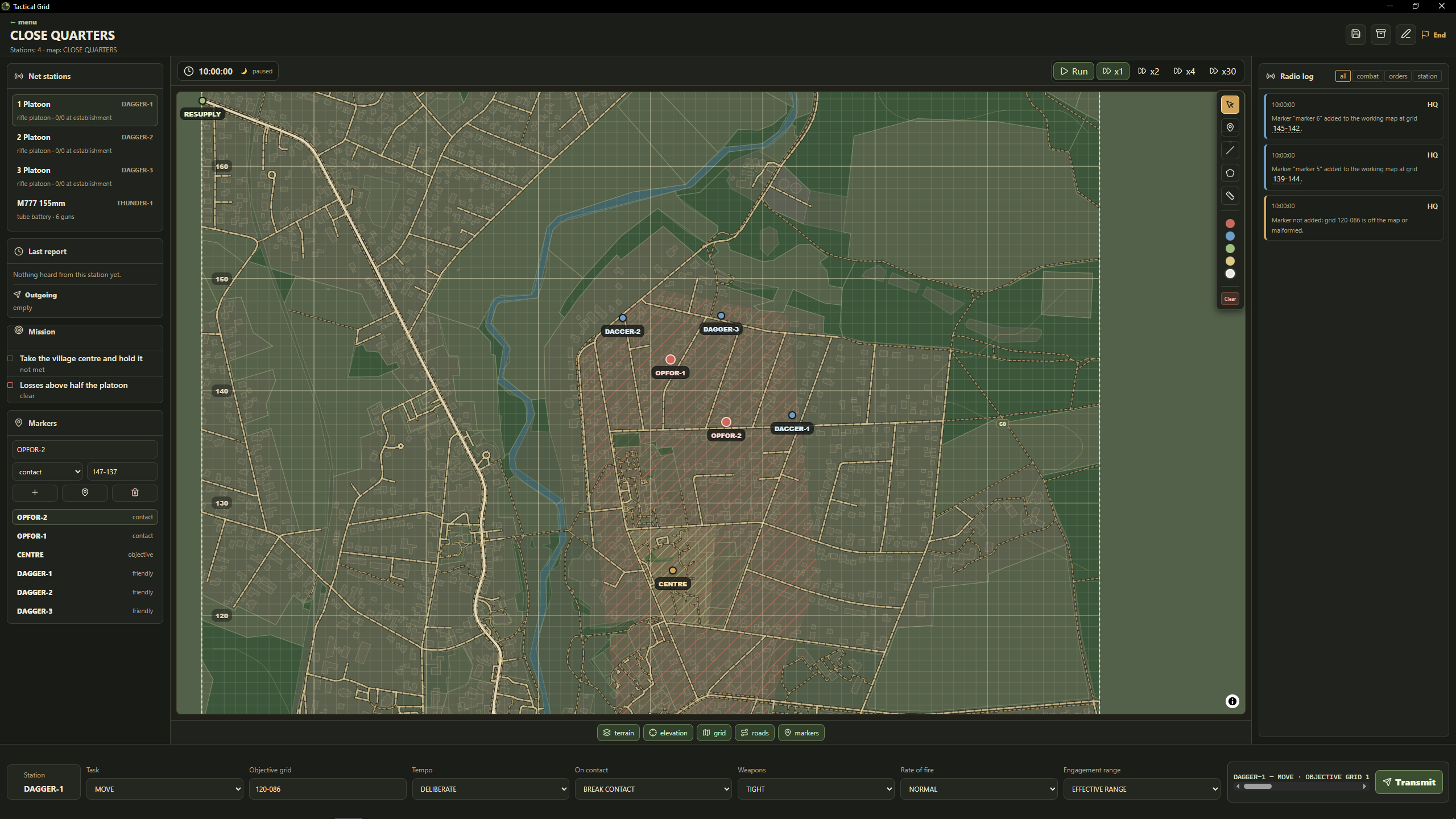
Tactical Grid is a real-time tactical command game about fighting with incomplete information.
You are not on the battlefield. You are at the tactical operations center.
There is no god-eye view of your soldiers. No live GPS tracking. No constantly updating unit icons telling you exactly where everyone is.
You have a topographic map, a grease pencil, and a radio.
Your troops see the battlefield.
You don't.
Your squads report what they see and hear over the radio. Reports take time to arrive and can occasionally be incomplete or wrong. You plot their reported positions on your map and build your own picture of what is happening.
Those marks do not move by themselves.
If a squad moves without reporting it, your map still shows where you last believed it was.
Then you have to make a decision.
Listen. Plot. Assess. Give orders. Wait. React.
And hope the picture in your head is close enough to reality.
The Battlefield Is Not Your Map
In most tactical games, the battlefield is something you can see.
In Tactical Grid, your map shows what you know, not everything that is happening.
A unit can move out of position and leave your map behind.
A radio report can arrive too late to matter.
A contact you marked as hostile may turn out to be somewhere else.
A squad can lose contact while under fire, leaving you with its last known position and nothing more.
You have to command with the information you have.
After the battle, you get to see how wrong you were.
Command, Don't Micromanage
Your orders set the plan. Your squads fight it.
Squads have their own tactical behaviour. They choose observation sectors, take available cover, react to incoming fire, and change their behaviour as their morale deteriorates.
Under pressure, they can become suppressed, go to ground, retreat, or break and run.
When a manoeuvre calls for it, different elements can act together without you controlling every movement yourself.
One group can suppress while another moves around a flank.
Your job is to decide what needs to happen.
Your soldiers decide how to fight their way through it.
Real Terrain Matters
Scenarios are built from real-world geographic and elevation data.
The ground is not a flat tactical backdrop. Hills, ridges, woodland, and buildings affect what units can see and how effectively they can engage one another.
Line of sight is calculated across the actual terrain.
Cover is affected by what lies between the observer and the target — including the amount of woodland or built-up terrain in the way.
A ridge that blocks the view on the real map can block the view in the battle.
A village is not just a collection of decorative buildings. It can turn a long-range engagement into a close-range fight.
Off-Map Artillery
Artillery is called in from outside the map.
You do not simply click an enemy unit and make shells appear.
Fire missions take time to arrive, and their effects are influenced by accuracy and dispersion. Artillery is something you have to plan around, not an instant response button.
You can use it to suppress a position, support an assault, or shape the battlefield before your troops arrive.
But you are still making the call without a perfect picture of where everyone actually is.
The Sound of a Command Post
The press of the handset. Carrier and static. The tone of an incoming report. Shelling somewhere off in the distance.
Every sound is generated in-game — there are no recorded voice lines, and nobody speaks.
Reports arrive as written messages, the way they would be taken down at a command post.
The result is a deliberately quiet experience: you are listening to a radio, reading reports, marking a map, and trying to work out what is happening somewhere you cannot see.
After the Battle, the Fog Comes Off
During the fight, you see only your commander's picture.
After the fight, you can see the truth.
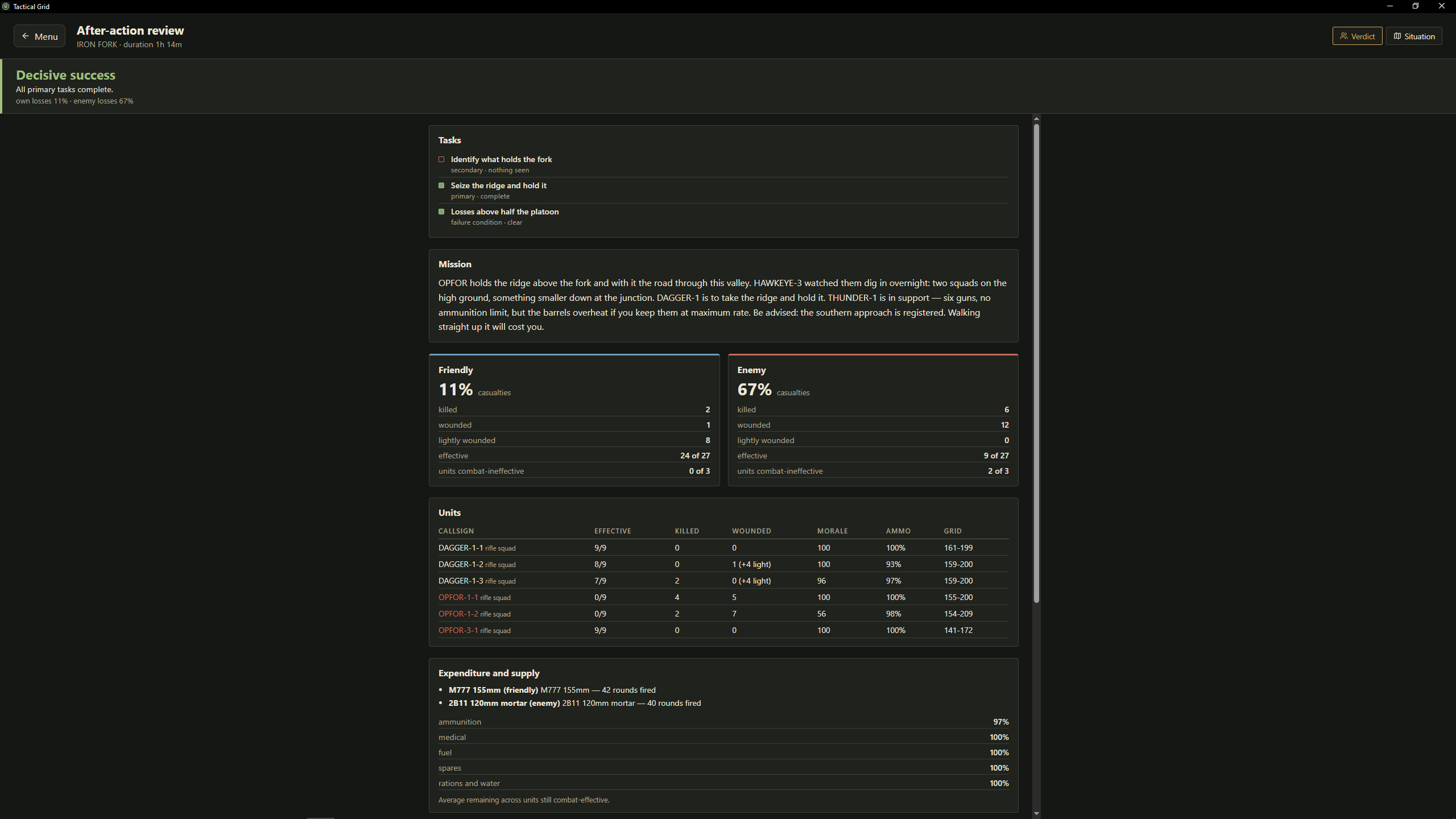
The after-action debrief reveals the battlefield as it actually was: where every unit on both sides actually was, what happened to them, how many were killed or wounded, and how much ammunition was fired.
The battle log lets you reconstruct the sequence of events.
You can compare what you believed was happening with what actually happened.
A good plan can fail because the information was wrong.
A bad plan can work because the enemy made the bigger mistake.
The debrief will not flatter you.
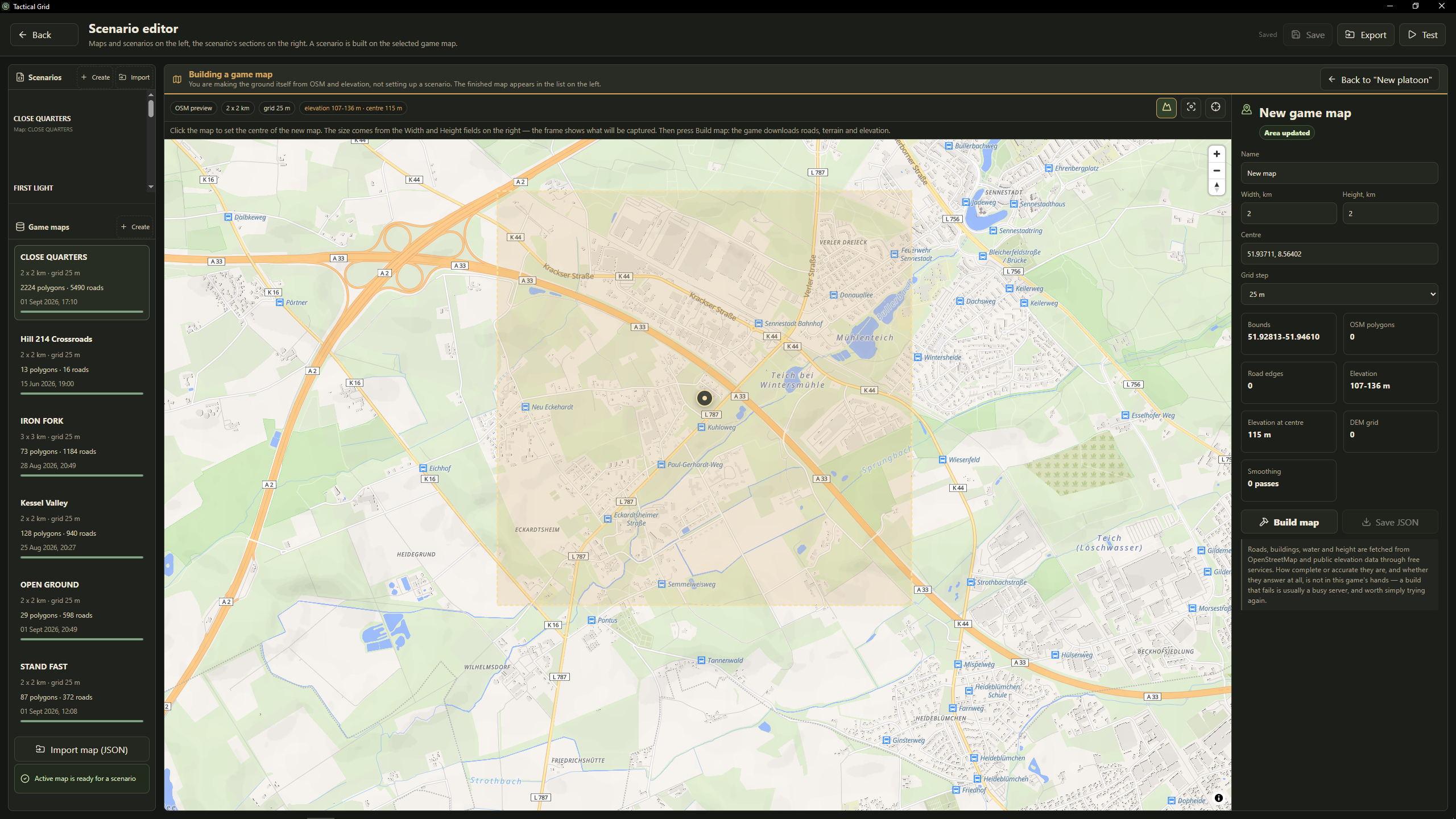
Real-World Scenario Editor
Build your own battles on real-world terrain.
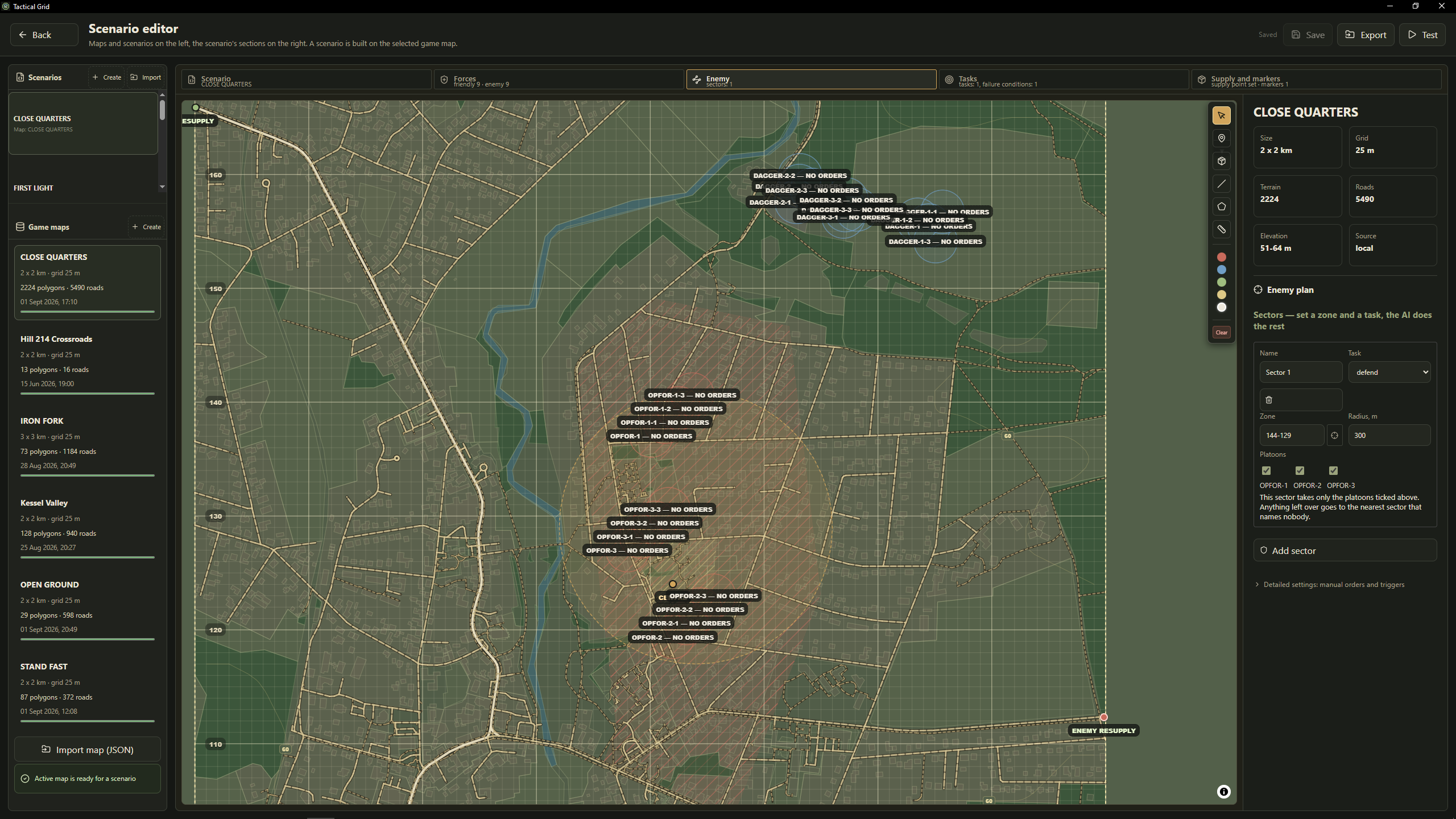
Choose a location anywhere on Earth, generate the available terrain data, place your forces, assign their objectives, and create a scenario to play through the same command system as the handcrafted missions.
Build a fight around your hometown.
Choose a ridge you know.
Recreate an engagement on real terrain.
Or simply pick somewhere that looks interesting and invent a battle there.
The editor uses the real-world data available for the selected location, so terrain and map detail can vary from place to place.
Generating a new map is the only part of the game that requires an internet connection. Once the map has been built, it is stored on your disk and the battle itself requires no network connection.
What You Can Build
The current game supports infantry and artillery.
The scenario editor lets you set up the forces, their positions, objectives, and the conditions of the engagement.
Vehicles are planned for future development.
A full terrain editor for manually changing generated terrain, correcting map artifacts, or creating completely custom battlefields is also planned for later development.
Included Missions
The full game includes five handcrafted missions designed to be played in this order.
1. First Light
Night reconnaissance.
Six men. Two teams. No supporting fire.
Identify what is holding a farm and get back without being seen.
First light comes at 06:15. After that, the darkness that protected you is gone.
2. Iron Fork
A platoon attack.
Take a defended ridge overlooking a road fork.
You have artillery support.
The enemy has already registered the open approach.
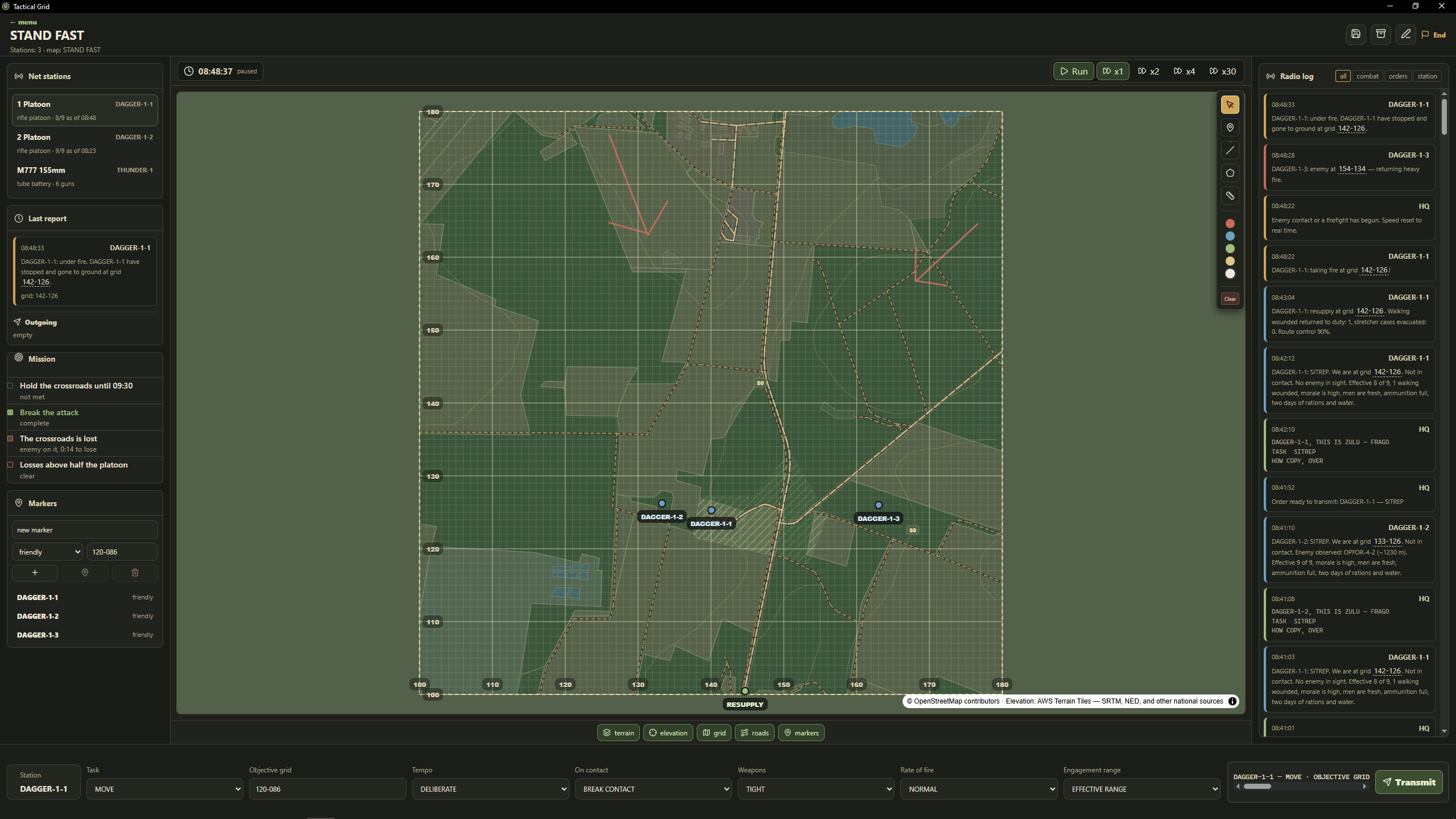
3. Stand Fast
Hold the crossroads.
Three enemy platoons are coming from two directions.
Hold the junction until 09:30.
The objective is lost when nobody of yours is left standing on it.
4. Close Quarters
A company fight through a village.
Buildings break up long sightlines and turn information into uncertainty.
You may know that the enemy is somewhere in the settlement without knowing exactly where — until they are suddenly close enough to shoot.
5. Open Ground
A meeting engagement on bare heath.
Equal forces.
Nobody dug in.
Almost nothing to hide behind.
Both sides are ordered onto the same hill at the same time.
There is nowhere to disappear.
The Demo
The demo is the first two missions: First Light and Iron Fork.
The first teaches the thing the game is about — six men, no supporting fire, orders not to be seen, and everything you learn arriving by radio. The second is the first time somebody shoots back: a platoon attack on a held ridge, with a battery on call.
It uses the same core systems and the same game engine as the full game. This is not a separate tech demo or a simplified combat sandbox.
The demo has no editor, so it never needs an internet connection at all.
The full version adds the remaining three missions and the scenario-building tools.
Controls & Field Manual
Left Click on the Map Read off a grid reference, place a marker, or set the objective for an order.
Drawing Tools Place markers, draw lines and zones, and use a ruler to maintain your own picture of the battlefield.
Field Manual The in-game Reference screen explains the order formats, map symbology, and grid conventions used by the game.
You can learn the game's order system as you play.
What Makes Tactical Grid Different?
You are not trying to maintain a perfect picture of the battlefield.
You are trying to make good decisions without one.
Your soldiers may know things you do not.
Your map may be out of date.
A report may arrive after the situation has already changed.
And when a unit disappears from the radio, you have to decide whether to wait, move, or act on the last thing you know.
The challenge is not simply to destroy the enemy.
It is to understand a battlefield you cannot directly see.
And sometimes, to realise afterwards just how wrong you were.
Community & User Scenarios
Tactical Grid is an active indie project, and player feedback is part of its development.
Share your battle reports, tactical experiments, and balance observations in the comments.
Scenarios created with the editor can be exported as ordinary *.scenario.json files and shared with other players.
Build something interesting, export it, and let somebody else try to command it.
Technical Notes
The game plays entirely offline. Nothing is checked online, streamed, or sent back to a server. Missions and generated maps are files on your disk, and a battle asks nothing of the network.
The only exception is generating a new map in the scenario editor. That requires an internet connection and normally takes around a minute, depending on the load on the public map services.
Map quality depends on the underlying geographic data and varies by location. OpenStreetMap coverage is extensive in much of the world, but some areas contain less detailed data.
Map data © OpenStreetMap contributors (ODbL). Elevation data from AWS Terrain Tiles. Editor basemap by OpenFreeMap.
Purchase
In order to download this game you must purchase it at or above the minimum price of $5 USD. You will get access to the following files:
Download demo
Comments
Log in with itch.io to leave a comment.
I like the idea of the game! However whilst playing the demo, I was never able to find the enemy. I did recon orders amongst the red hatched area. (I believe that was where they were?). I went back forth there a bunch but never found anyone.
So,far I'm interested, though. Something that would be nice, when a unit confirms their arrival at a point. When their coordinates are generated, having a click to move your cursor or plot a marker to that position would be nice.
I'm glad you're interested in the game. I checked the mission but didn't find any issues. I'll take a closer look, but for now I'll add a second mission to the demo so you can really test out the combat system.. You can add a marker or record the coordinates in the order by right-clicking on the coordinates. The ability to center the camera based on coordinates and copy coordinates will also be added
I added a second mission and the ability to center the camera by clicking on coordinates, but I can't seem to recreate the situation from the first mission. What exactly was the problem—were there no reports on the enemy, or was the objective not being completed?
I kinda did a zig-zag pattern search pattern in the red zon. Using recon order. Although after spending some time doing that. I never got any enemy reports. Could be I just missed them!
Cool, I will check that out!